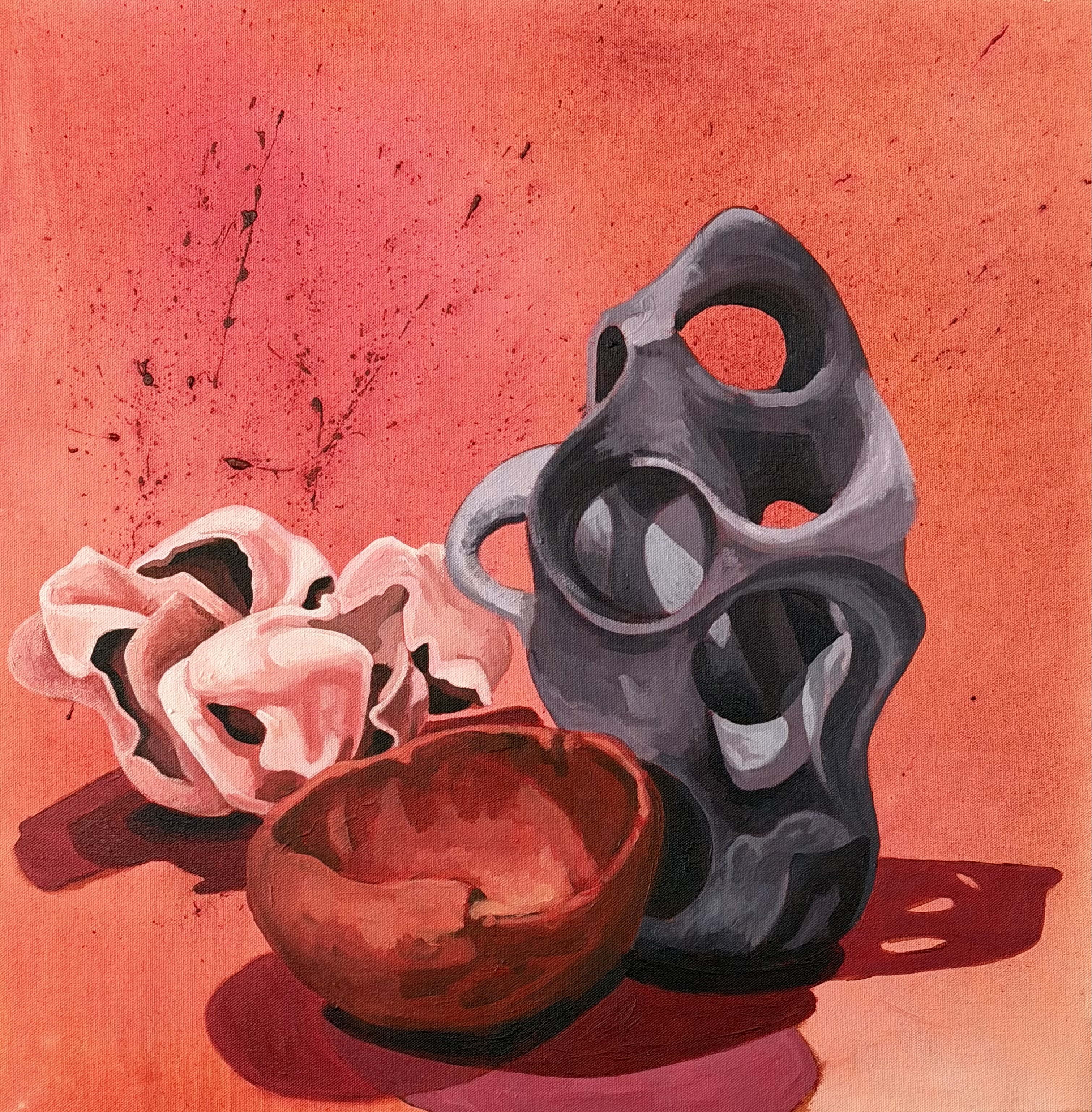
Japanese ceramics from the Asian Art Museum, San Francisco. Robin L. Chandler 2026
“If we refuse to see what is coming, expedited by our unwillingness to make the necessary changes to not just survive, but flourish, then we are the creators of our own demise. Change is upon us and change is within us. Whatever future may be collapsing before our eyes, we can dream a new world into being. We can protect what is vulnerable and restore and rebuild what remains with love for those who will follow us.” p. 306
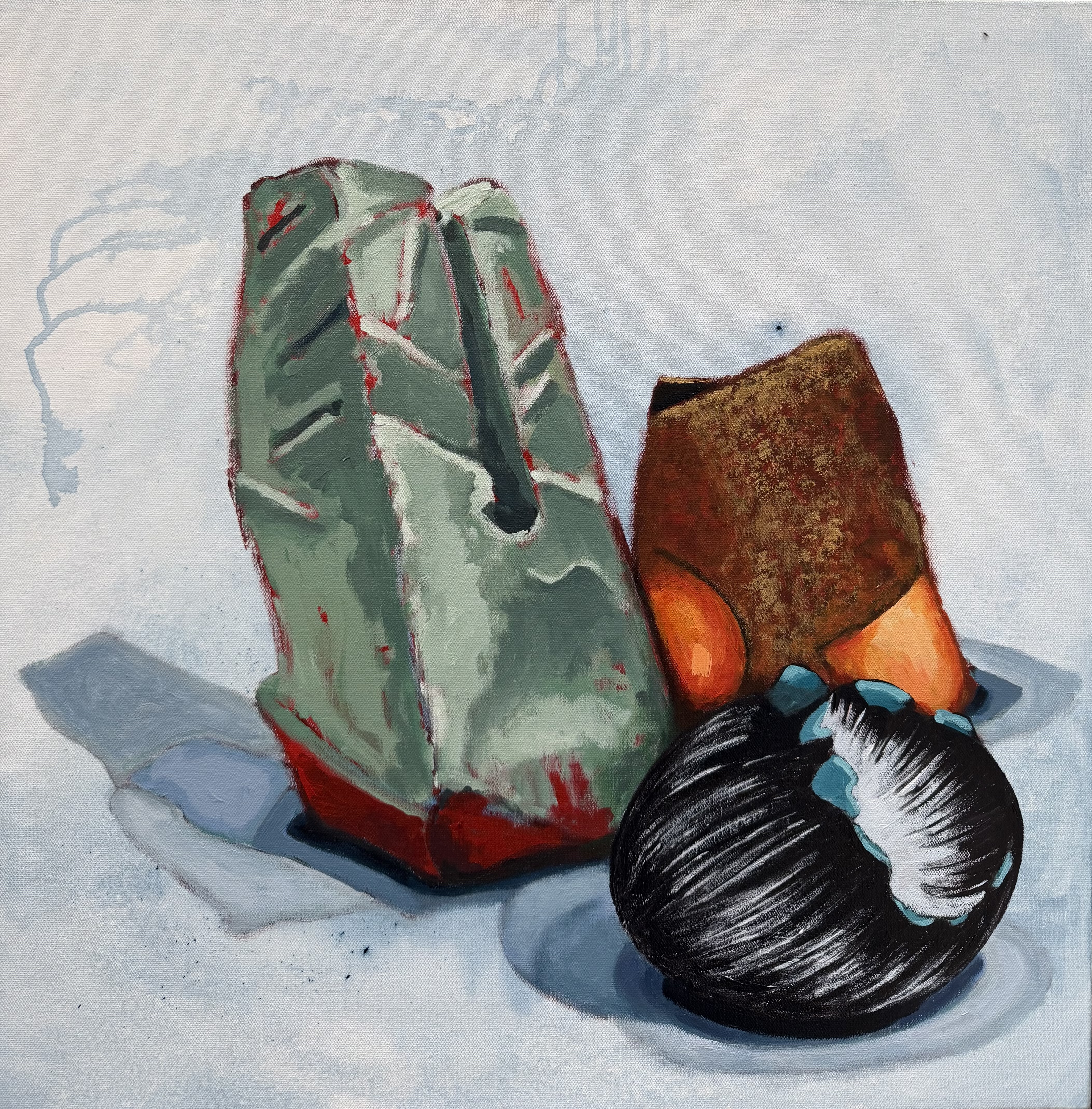
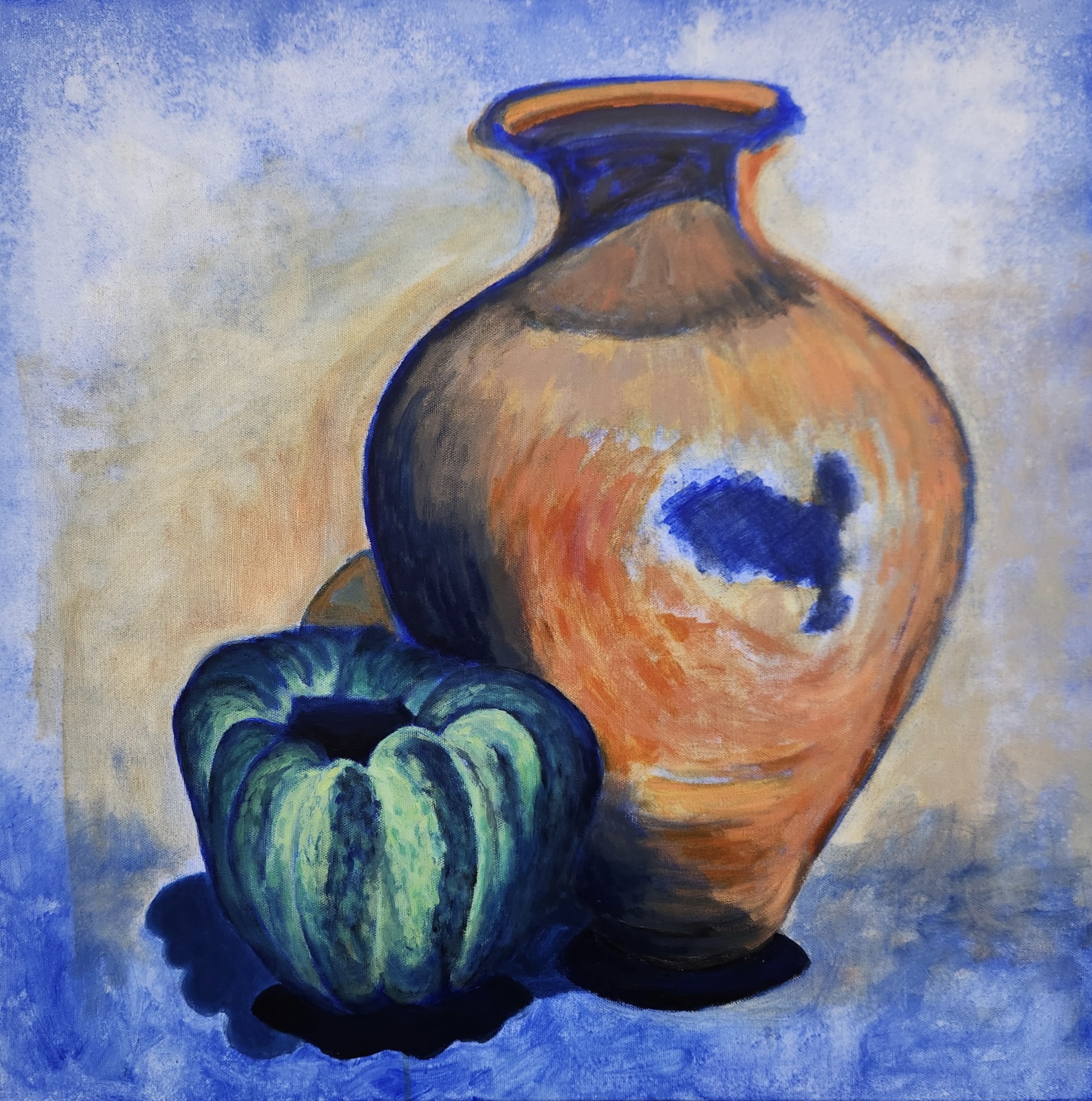
Japanese ceramics from the Asian Art Museum, San Francisco. Robin L. Chandler, 2026
“Why does ‘the land’ have to give something back to the writer? Why do we need to imagine, manufacture, or ‘experience’ some kind of bridge between self and ‘wild’ to give purpose to writing the land?” p.vii
“As globalization draws us together and industrialization and human population pressures take their toll on natural habitats, as species of plants and animals flicker and are snuffed from the earth, it may be worthwhile to ask whether an ethnocentric view of human beings as a species independent from others underpins our exploitation of natural resources and sets into motion dire consequences.” p.1
“There are, of course, long traditions of the pastoral, poetry centered on nature or landscape, in both Eastern and Western language literature. I, myself, am less interested in ‘nature poetry’ – where nature features as theme – than in poetry that investigates – both thematically and formally – the relationship between nature and culture, language and perception.” p.2
“Poetry doesn’t simply supplement the rational intellect but provides inherent and sometimes incommensurable forms of insight. Because its meanings are neither quantitative nor verifiable, poetry may offer different, subtler, and more complex expressions than the language of information and commerce. An ecological poetry might even…” p.3
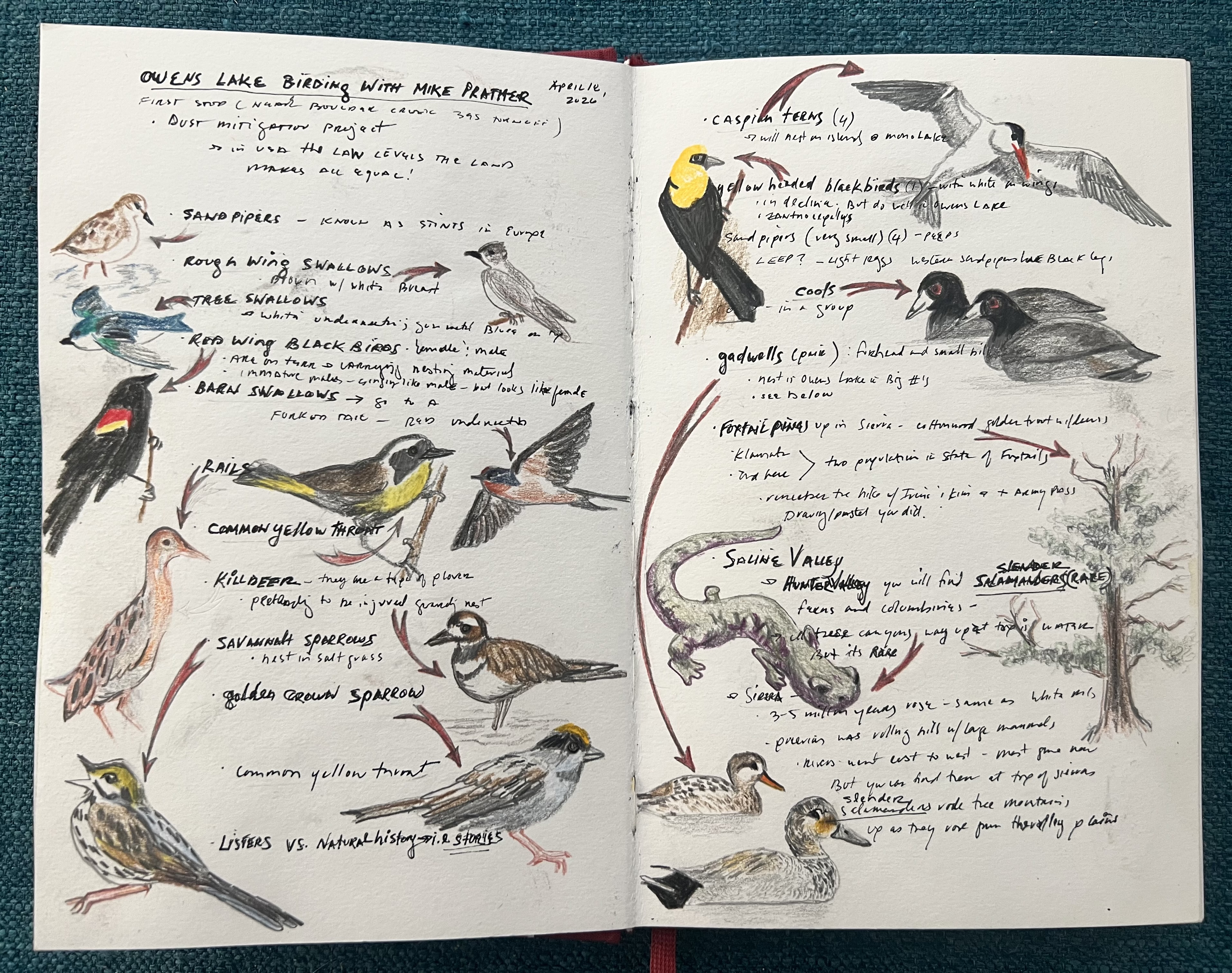
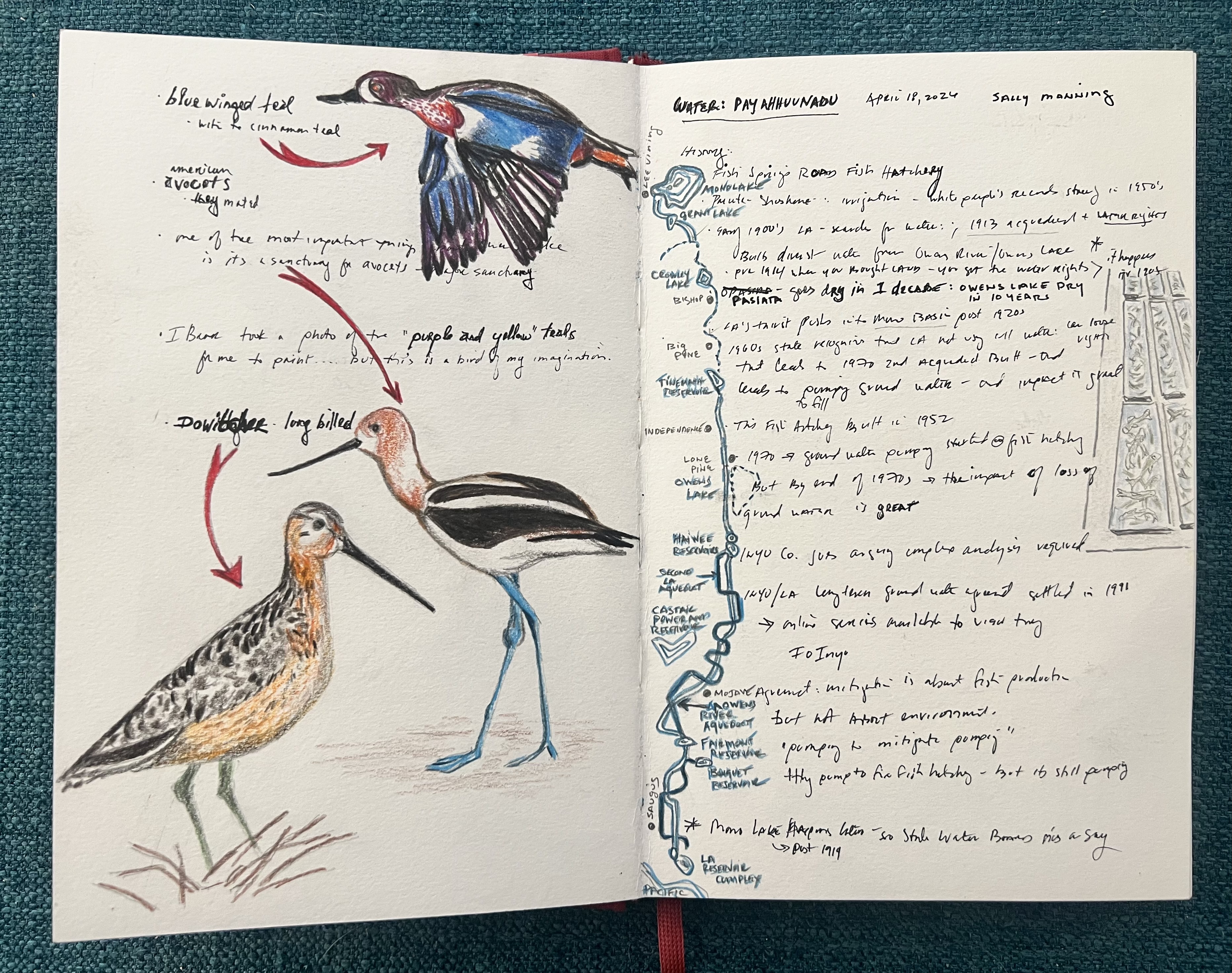
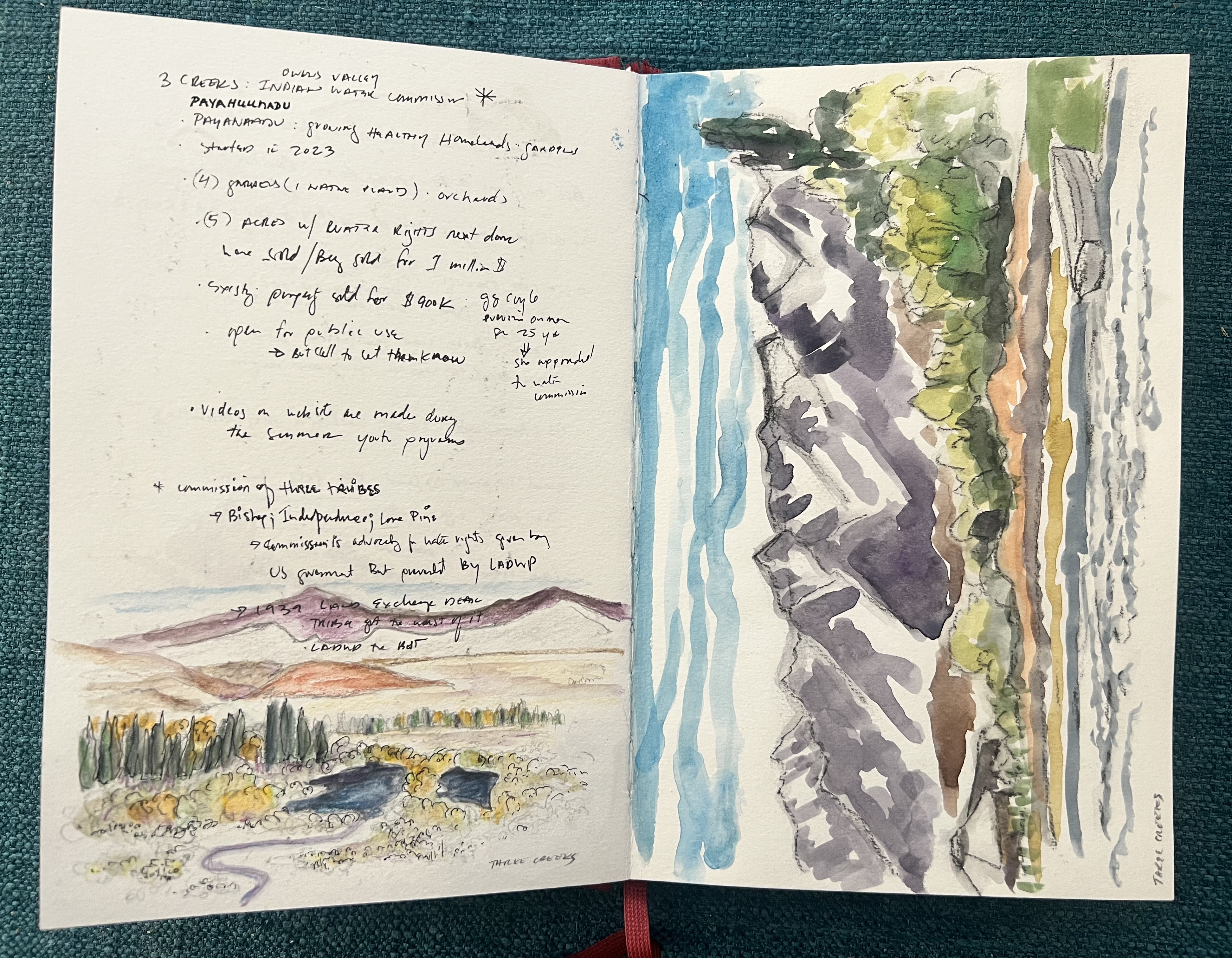
“Pleistocene-era Owens Lake formed eleven thousand years ago, when the huge glaciers that covered the Sierra Nevada melted and plummeted down the Owens River to the lowest point in the valley. It was over 200 feet deep and 200 square miles in area. That massive lake evaporated over time into Owens Lake, which covered 100 square miles and was slightly salty, mainly because of sodium bicarbonate, or “soda.” Then, settlers compressed geologic time into a matter of years. After the U.S. Army murdered or removed many of the regions Native Californians during the Owens Valley Indian War, white homesteaders began diverting water from the Owens River for farming and ranching. Then came Los Angeles and its aqueduct. By 1924, the lake was completely dry. The salts left behind precipitated into a crust of trona, burkeite, halite, potash, potassium, chloride, and borax. And dust. ….. By the 1990s, the bed of Owens Lake was releasing 76,000 tons of dust east year. It had the highest measurement of particulate matter in the United States. ….. Great Basin Unified Air Quality Control District, the agency responsible for enforcing air quality rules in the Eastern Sierra region, started monitoring air quality at Owens and Mono lakes in the 1970s. ….. With the law finally on its side, in the early 1990s, the air pollution control district sued the Los Angeles Department of Water and Power over Clean Air Act standards. The big-city utility tried to starve out the rural regulation agency, filing seven countersuits. But in 1997, the courts decided in favor of Great Basin. They mandated that Los Angeles provide dust mitigation on an initial thirty square miles of lakebed. ….. They created a habitat where algae and brine flies flourished, providing food that attracted birds. ….. In 2002, the National Audubon Society declared the lake an Important Bird Area. Survey teams organized by the Eastern Sierra Audubon Society counted over seventy species in a single day, including fifteen thousand eared grebes, eleven thousand least sandpipers, nine thousand avocets, and twenty-seven thousand California gulls.”
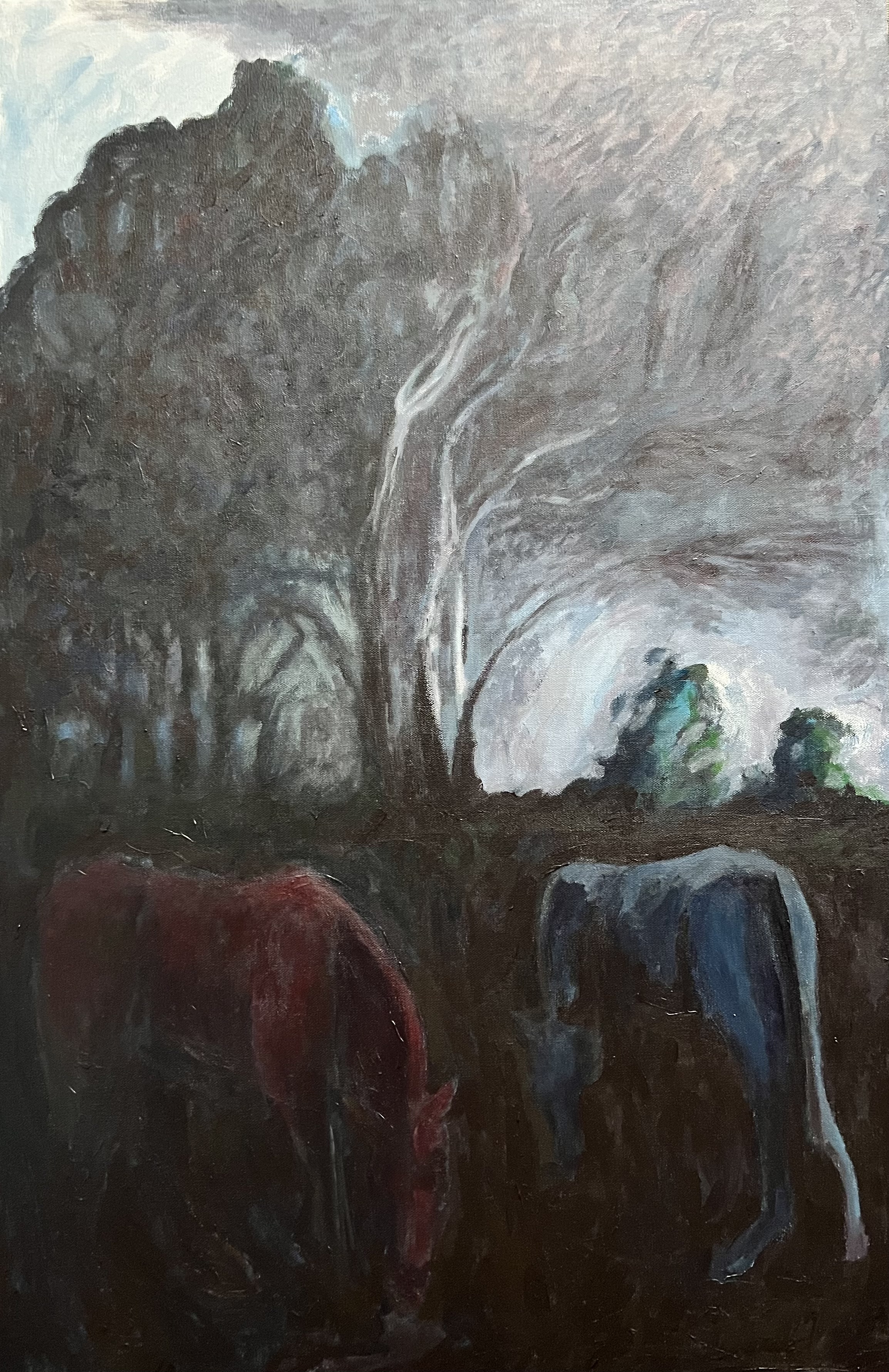
Twilight in a Bishop, California field. Robin L. Chandler, 2026
“It was known, in the area, that she walked the perimeter of the forest, the fringes of the trees, in later afternoon, in early evening, her falcon swooping into the branches and back to land on her leather gauntlet. She took out the bird at dusk so, if you were of a mind, you could arrange to be walking in the area.
If asked, the girl – a woman, now – would remove the falconer’s glove and hold your hand, just for a moment, pressing the flesh between thumb and forefinger where all your hand’s strength lay, and tell you what she felt. The sensation, some said, was dizzying, draining, as if she was drawing all the strength out of you; others said it was invigorating, enlivening, like a shower of rain. Her bird circled the sky above, feathers spread, calling out, as if in warning.”
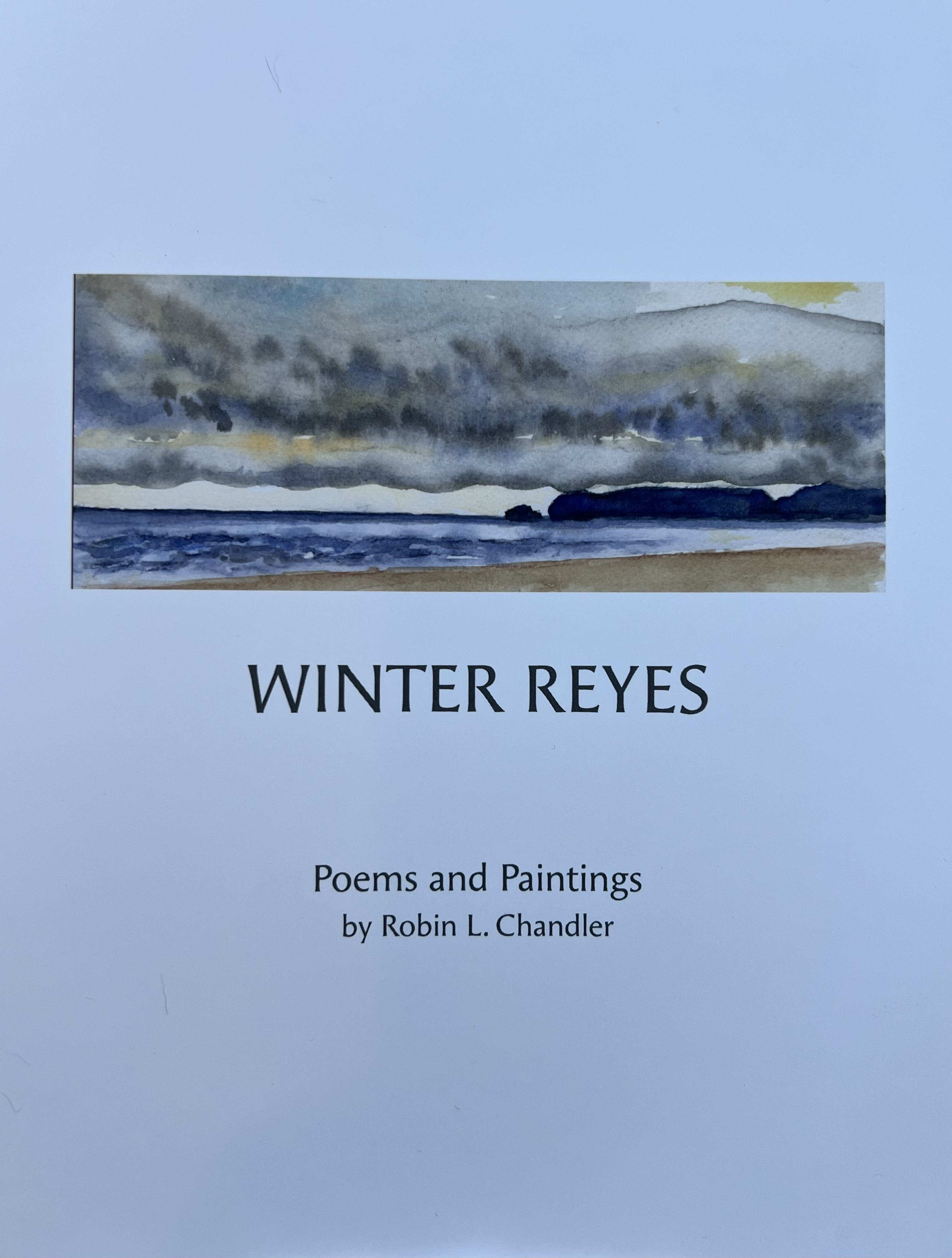
Cover of the book Winter Reyes: Poems and Paintings by Robin L. Chandler
The vernal equinox arrived and brought a blast of summer in typically springtime March. But I’m holding on to the memories of rain and wind, cold nights, frosty mornings, and blue winter light. And luckily, I can easily reconnect by opening a book that captures the feeling of winter in painting and poetry.
Inspired by my midwinter hikes, Winter Reyes rejoices in the hibernal beauty of Point Reyes National Seashore and shares the hope I find in nature’s resilience. My paintings and poems commemorate this jewel of the National Park Service. Copies of the book can be purchased on my website. I hope you have as much pleasure reading as I had in the making.
“reaching the bridge, the water parts, brush arches to the block page
Wet on wet, the work begins, the atmosphere emerges
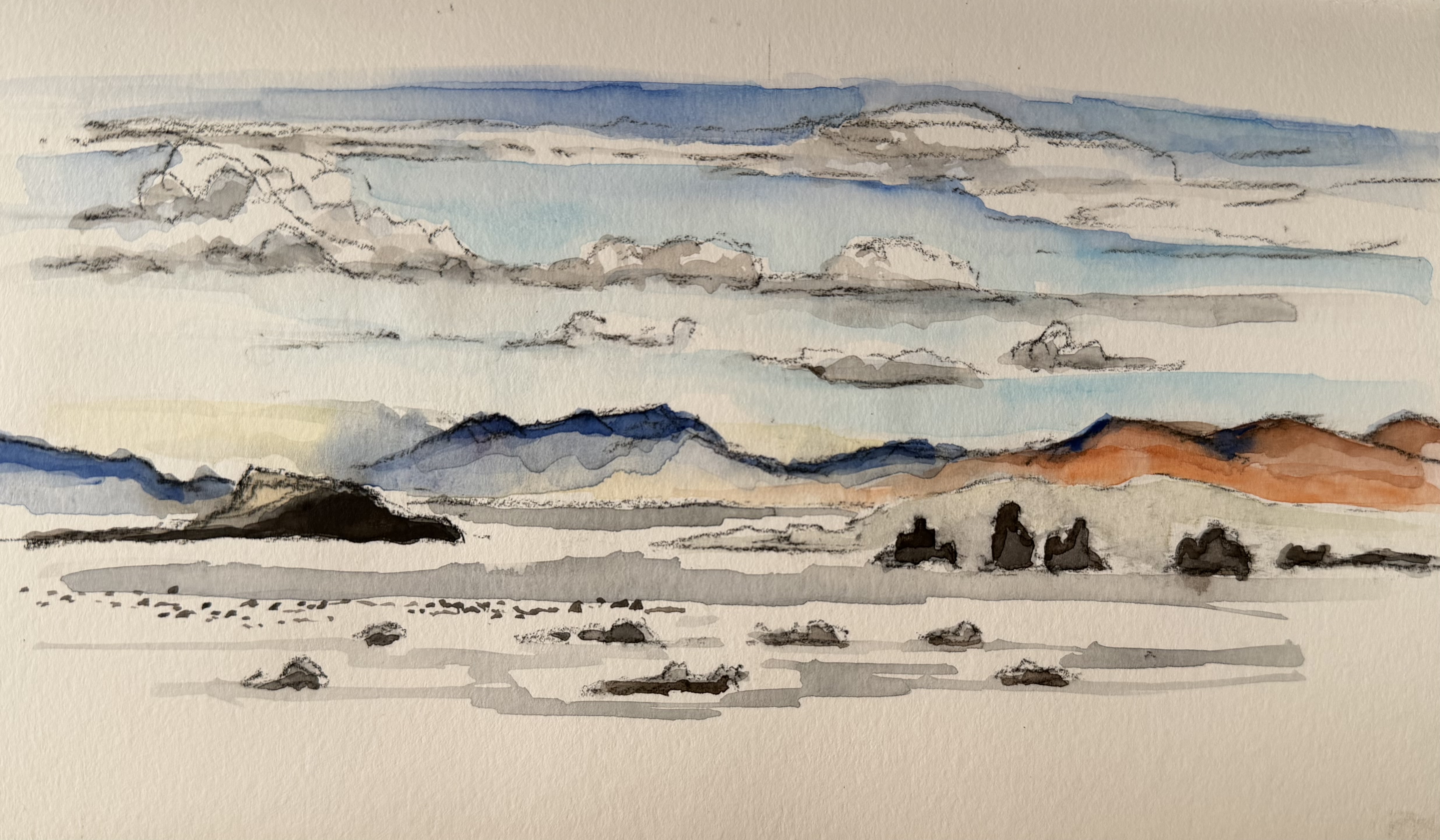
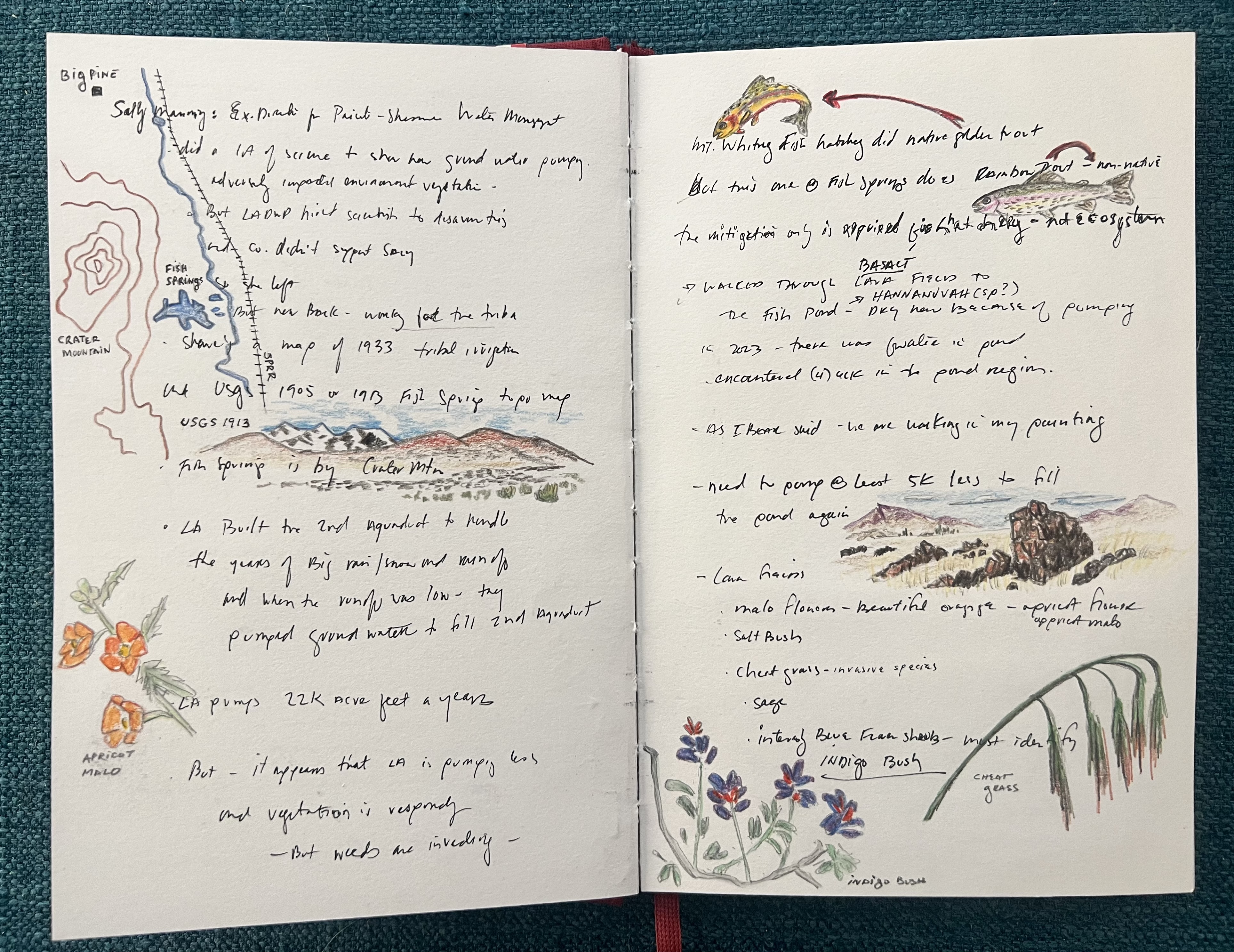
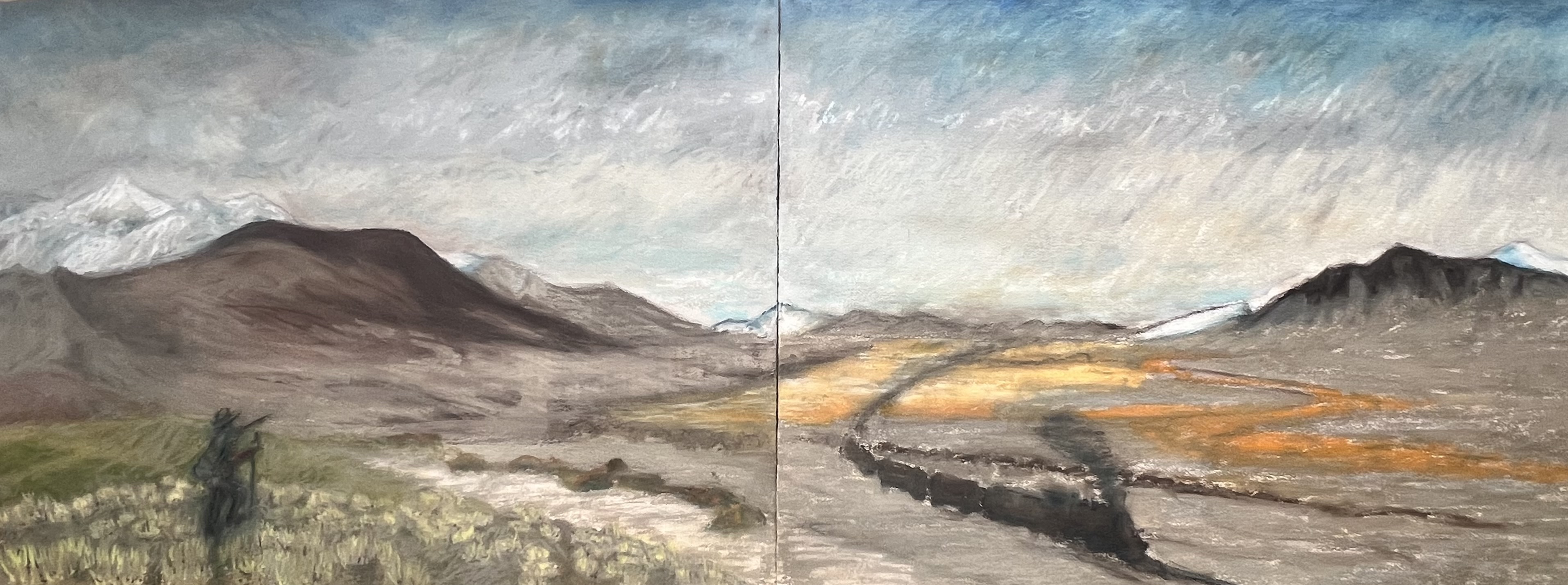
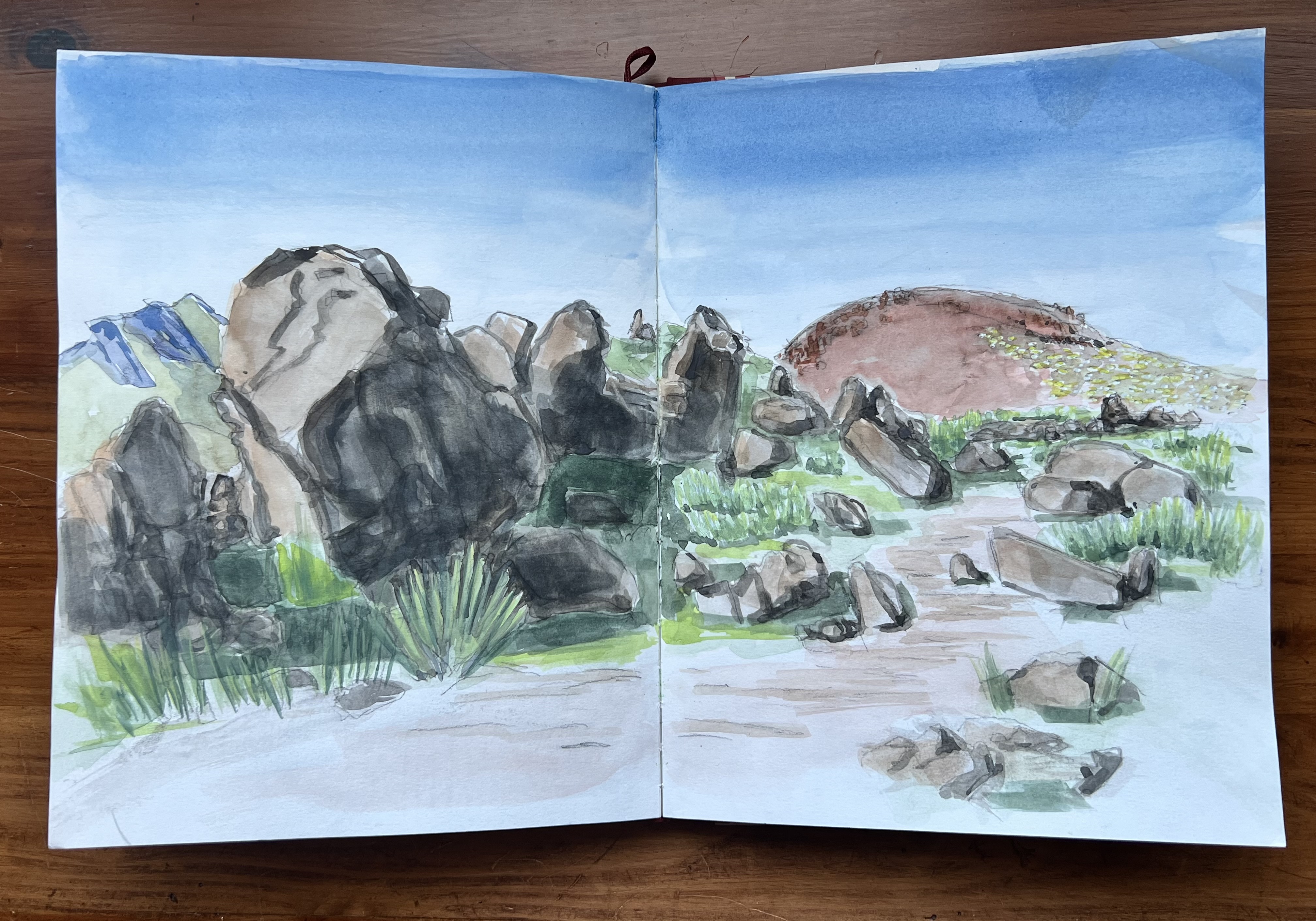
Sketch of the Coso Volcanic Field and Red Hill near Fossil Falls, Owens Valley. Robin L. Chandler, 2026.
The production of a work of art throws a light upon the mystery of humanity. A work of art is an abstract or epitome of the world. It is the result or expression of nature in miniature. For, although the works of nature are innumerable and all different, the result or the expression of them all is similar and single. Nature is a sea of forms radically alike and even unique. A leaf, a sunbeam, a landscape, the ocean, make an analogous impression on the mind. What is common to them all, — that perfectness and harmony, is beauty. The standard of beauty is the entire circuit of natural forms, — the totality of nature; which the Italians expressed by defining beauty “il piu nell’ uno.” Nothing is quite beautiful alone: nothing but is beautiful in the whole. A single object is only so far beautiful as it suggests this universal grace. The poet, the painter, the sculptor, the musician, the architect, seek each to concentrate this radiance of the world on one point, and each in his several work to satisfy the love of beauty which stimulates him to produce. Thus is Art, a nature passed through the alembic of man. Thus in art, does nature work through the will of man filled with the beauty of her first works.
Excerpt from Ralph Waldo Emerson’s essay Nature published in Ralph Waldo Emerson Collection: Collected Essays and Lectures (p.9)published in 1849.